Case study 06
Reminder Architecture
Maison Museau (anonymised): a lifecycle diagnostic for a French-market, printed-to-order pet-goods brand inside a three-brand group. Five reminder series were doing three jobs; the work was to identify which series earned, which were twins, and what to rebuild first.
Under NDA: the company is a stand-in and every figure below is a representative proxy. The diagnosis, working rule, and recommendations are the original work.
- Company
- Maison Museau (anonymised)
- Role
- Senior CRM Diagnostic
- Product
- Custom pet prints, France
- Platform
- Klaviyo, Shopify
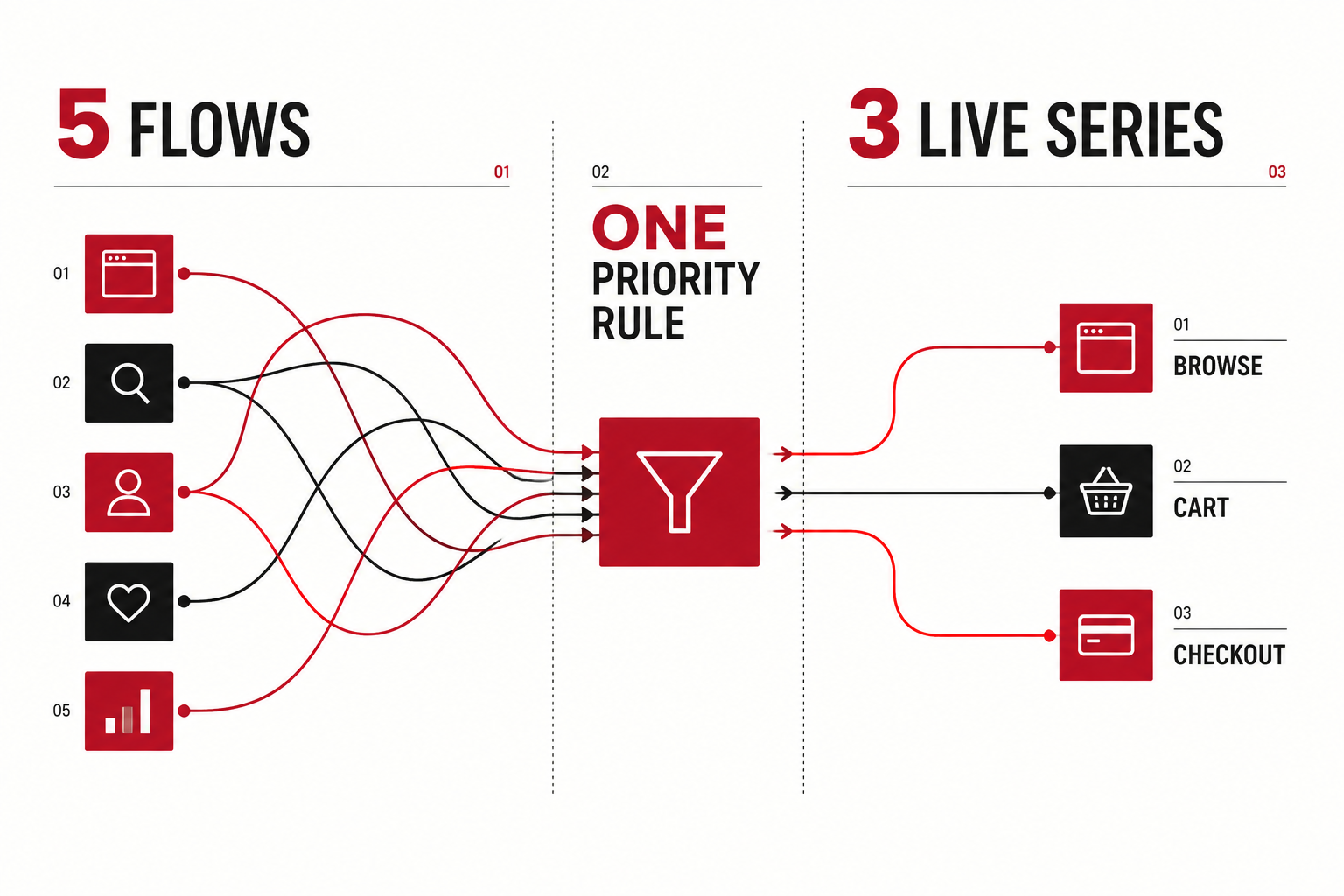
- Reminder series
- 5 → 3
- Checkout revenue / recipient
- €2.81
- Browse at scale / recipient
- €0.34
Anonymisation note
The company name and every commercial, audience, and performance figure in this case study are representative proxies.
The strategic problem, working rule, analysis, and recommendations are the original work. Klaviyo and Shopify remain named because the architecture depends on them.
The problem
Maison Museau sells custom printed pet goods.
A shopper uploads a photo, the configurator renders a preview, and the product is printed to order. Nothing on that shelf is about to run out. The French-language reminder setup had grown two browse series, two added-to-cart series, and one abandoned-checkout series that actually made money. Smart Sending was off, so one afternoon on the site could trigger more than one reminder. Subject lines still said hurry and almost gone.
- Decide what to change first using 90 days of live reminder data
- Resolve duplicate native and server-side journeys without losing coverage
- Move pet and preview data into email without turning the ESP into a second filing cabinet
Reading the setup
Some of the complexity was deliberate.
Checkout was split by previous purchase count, a server-side tracking layer caught shoppers the storefront missed, and each twin tried to stop the other from mailing the same person. The rest was residue: old names on server-side copies, inconsistent checkout events, unused analytics events, and an unfinished second cart email. Klaviyo attribution is not incremental lift, so every series was read on its own rather than adding the totals together.
| Series | Recipients | Unsubs | Rev. / recip. | Attributed |
|---|---|---|---|---|
| Abandoned Checkout | 18,760 | 247 | €2.81 | €52,716 |
| Added to Cart · native | 2,210 | 31 | €2.46 | €5,437 |
| Added to Cart · server-side | 1,180 | 22 | €2.31 | €2,726 |
| Browse Abandonment · native | 1,760 | 20 | €0.73 | €1,285 |
| Browse Abandonment · server-side | 28,400 | 391 | €0.34 | €9,656 |
The working rule
Started checkout beats added to cart.
Added to cart beats viewed a product. That is the order the live series should respect. It is also why collapsing the twins comes before any creative test: if two tools report one action as two journeys, a holdout on email two is unreadable.
- Do not fall back to Shopify only: server-side browse reached far more identified shoppers, while native cart caught meaningful coverage the server event missed
- Keep Shopify connected for history and coverage; fold its twins into the server-side journeys rather than switching the integration off
- Re-entry permission is not the same as a 30-day entry filter: the first lets a new behaviour restart a journey, while the second can keep the door shut
Recommendation 1: three live series
The twins existed because two tracking tools reported the same action, not because someone designed a useful split.
The end state is one browse series, one added-to-cart series, and one abandoned-checkout series. Build the overlap evidence first, fold in the Shopify twins, then stop them.
- Start each journey from one server-side event; use the matching Shopify event as a de-duplication filter
- Finish cart on one canvas with a 30-minute wait and two live emails—no unfinished box
- Build seven-day overlap segments for both pairs and count Shopify-only behaviours before switching anything off
- If Shopify-only coverage is material, keep native as a gap-filler where the server-side event equals zero, or write one shared event
- After overlap is resolved, turn Smart Sending on and suppress browse or cart when custom checkout or an order occurs
- Add French language as a join rule on checkout so the wrong profiles enter, wait one minute, and leave
Recommendation 2: hold out browse email 2
The second server-side browse email reached roughly 13,250 people, produced about €0.15 per recipient, and drove 188 unsubscribes.
These products are printed to order, so scarcity language is false. After consolidation, split the live French journey 50/50 after email one and a one-day wait: half receive email two and half receive nothing.
- Read revenue per recipient, orders, and unsubscribes over five days
- Run for at least two weeks; the smaller native journey cannot carry the decision
- Leave checkout email one alone while this test runs—it remains the strongest individual message
Recommendation 3: stop stacking 10% then 15%
The first checkout email does the work.
The third email's larger discount does not outperform the second email's smaller discount on a colder audience. Escalating the offer gives away more margin without a visible conversion gain.
- Hold out email three, or test email two as no code versus 10%
- Judge on revenue per recipient and margin—not conversion alone
- Do not copy the French discount ladder into other markets before it proves incremental value
- Check sale overlap, event coverage, subject-line variants, and people versus messages before treating an attributed row as causation
| Offer | Recipients | Conversion | Rev. / recip. | |
|---|---|---|---|---|
| Email 1 | No code | 7,010 | 7.6% | €4.55 |
| Email 2 | 10% | 5,160 | 2.7% | €1.36 |
| Email 3 | 15% | 4,820 | 2.5% | €1.21 |
Pet data into email
The shop already knows the pets and the previews.
Email should listen to that system, not become another master file. Pet name, type, and photo can refresh on the customer overnight after an order. A preview-created event must arrive immediately because it powers a same-visit reminder. Match people on shop email plus a stable customer number; with neither identifier, log the event and do not send.
- Store up to five pets as structured customer data, never one block of text
- Send preview created as a live event carrying the image, pet name, and product from that visit
- Keep the customer data platform as master; email subscribes and refreshes overnight
- Reuse the integration pattern across the other group brands, but keep pet and preview facts scoped to this brand
One flow: recover the preview
A generated preview is a more expensive moment to waste than a plain product view.
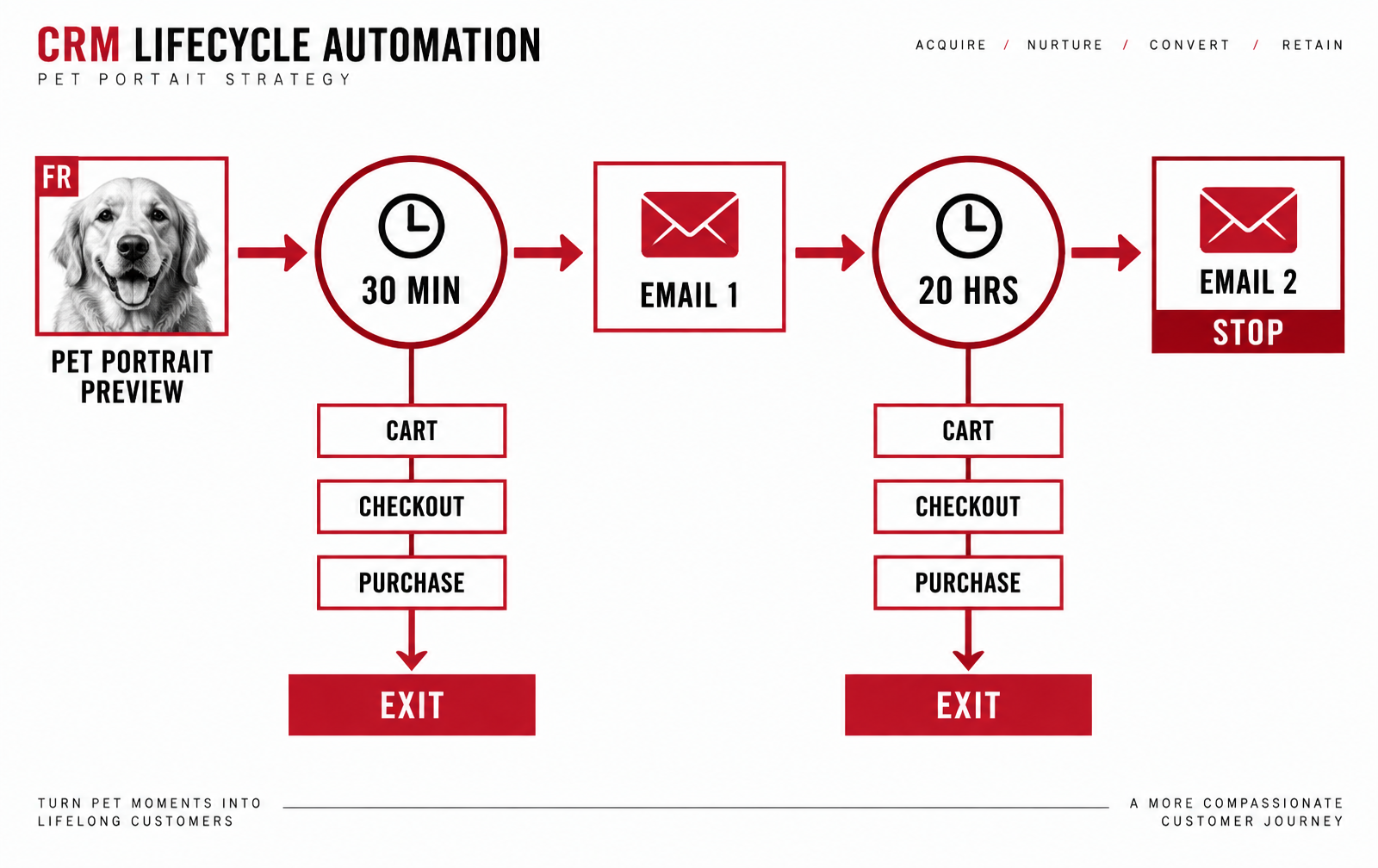
The recovery journey reaches an identified French shopper who opened the designer, saw their pet on a product, and left without buying. It sits above browse, below checkout, and beside cart—with a 24-hour contact rule preventing those journeys from mailing together.
- Start immediately on Preview created; a nightly import is too late
- Require French language and a known identity, with no order, custom checkout, or server-side cart event since start
- After 30 minutes, recheck and send the personalised preview with the pet's name—no discount and no false scarcity
- After 20 hours, recheck again; cart, checkout, or purchase exits the journey
- Send one final no-code reminder or stop, then allow re-entry after 14 days
The result
This was a diagnostic, not an implementation, so it does not claim invented uplift.
It left behind an executable system: three journeys instead of five twins, a priority rule that prevents collisions, two tests that become readable after consolidation, and a data pattern that spends the high-intent preview moment before a generic product view does.
- Clean the architecture until a test can speak—then test
- Do not read attributed revenue as incremental lift without a holdout
- Do not let two tools report the same visit as two customer journeys
Want this built on your account?
View packages or book a discovery call. Send the platform, list size, and what's broken.